Tusayan, Arizona in late December is antithetical to her location; she’s tarmac and ATV’s; Wendy’s and Texaco less than five minutes from the federally protected land of Grand Canyon National Park. Mostly, she’s empty this time of year. The private company which advertises ‘adventure tours’ in open-framed hot-pink Jeeps beside the visitor centre is without motion save for a singular employee policing which side of the expansive parking lot park visitors are allowed to access, and which side is reserved for the still rows of identical Jeeps. Lines, most of them invisible, could explain many a significant event, but more relevantly here, and across the States, lines explain the radical whiplash in the confluence of land we deem ‘conservable,’ and land we don’t. Two miles ahead is a million acres of red rock and Pinyon pine; a million acres of the rare luxury of being pitch-dark come night. Tusayan is not quite a strip mall, but it’s well on its way; Tusayan is empty but no less bright. Watahomigie-Corliss, a Havasupai tribal member speaking on this issue in a centennial retrospective of Grand Canyon National Park, remarked ‘Borders. The park service showed up and told us what the borders were.’
Conservation is a particularly difficult notion to negotiate within the American consciousness. What can conservation mean, and what could it look like, in the face of American exceptionalism, mythologies of liberty, and a latent colonial legacy? After two rounds of ecologically disastrous National Park understaffing in the wake of the government shutdowns, and the consistent threat of funding cuts under the Trump administration—land, and our relation to it has become the subject of constant redefinition.
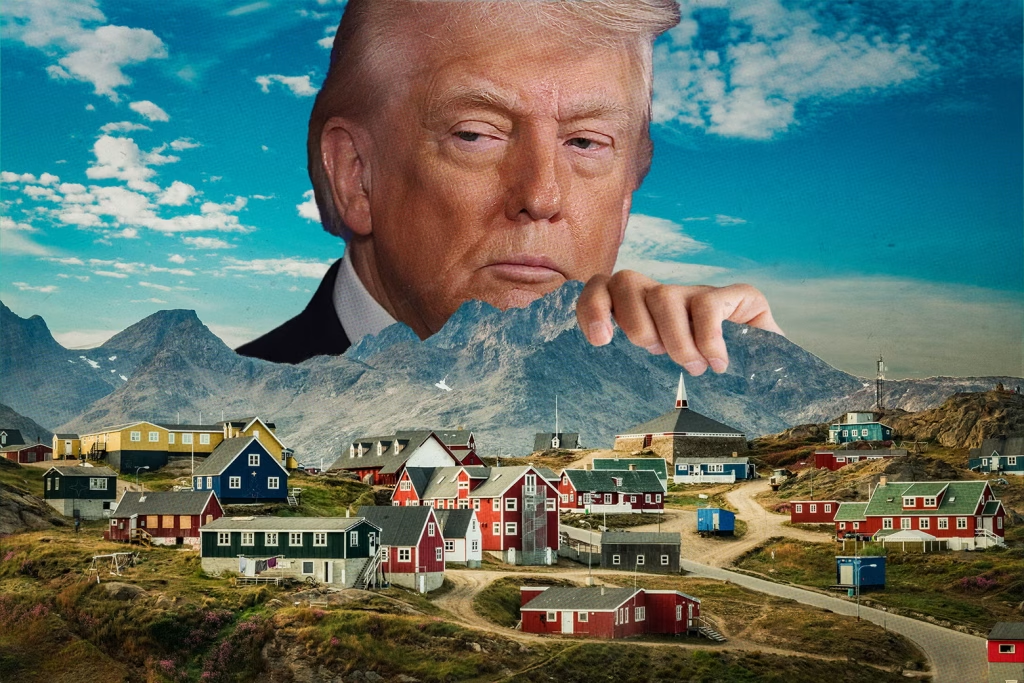
Recent decisions to issue the 2026 National Park pass as a collage of Trump and Washington exemplifies what Allen, Connauton, and McCreary refer to as a ‘memorialization of white conquest,’ one which carries deliberate consequence upon cultural memory. Stone Mountain, a confederate memorial, and Tȟuŋkášila Šákpe, otherwise known as Mt. Rushmore—both examples examined in the paper, remove this frankly vulgar and tasteless self-aggrandizing attempt from isolation, and define these various forms of continued colonialism and subversive land commodification as not necessarily a ‘Trump’ problem, but rather a larger ‘America’ problem.
At its origin, ‘conservation’ was built upon something close to a contradiction. Beyond the tired outrage of loggers and cattlemen, the emphasis on the ‘natural,’ and the intentional delineation between the human and the natural is an ethos pervasive behind the foundings of the first National Parks in the United States, and it’s an ethos which disregards entirely the vast history of the Indigenous Peoples who have resided in Yellowstone, Yosemite, and every other National Park for upwards of tens of thousands of years, far before their lands would ever come to be known by these names. The invisibility of Indigenous land claims in the context of conservation is one intrinsically tied to an ‘othering’ Euro-American cultures project upon Indigenous Peoples. From Rousseau to James Cameron, the exoticisation of the ‘Noble Savage’ myth endlessly positions Indigenous Peoples on the side of broad ‘environmentalism’ and ‘conservation’ without nuance.
This leveling of complexity and interests is able to mask any Indigenous concerns which may be raised because it carries with it the consequence that any and all forms of conservation must be inherently within their interests. It facilitates the conclusion that without National Parks, their lands would have been lost to the loggers and cattlemen; it facilitates the dismissal of Indigenous displacement. The opposite pole of this ‘othering’ of Indigenous Peoples, perhaps the side the pendulum is now swinging into under the Trump Administration, is the more blatant ‘Ignoble Savage.’ This is the bad-faith and reductive faux-hysteria over whale-hunting, over Native-owned casinos, and this is the Trump Administration’s attempts at invoking colonial and anti-Indigenous rhetoric to revoke birthright citizenship, and these arethis is the continued harrowing consequences of ICE and their ironic bigotry in defining legal residence.
Presently, the nature-culture dualism and materialist frameworks popular within sociology and anthropology are largely preoccupied with an Euro-American worldview, one not universally applicable to differing cultures of nature and the environment. The American ideal of a virgin ‘wilderness’ absent of human activity, and the analogous ‘civilization’ where human activity must be allowed to progress without restraint, at once skirts by Indigenous history and presence, all the while pretending this segregation benefits them. This means displacing Indigenous communities in the name of ‘land conservation,’ land which belongs to them, in an unbalanced model of ‘sustainability’ as they over-extract natural resources from land they deem ‘unworthy’ of conservation. Whether this is the Alberta tar sands, or the landfills in West Kauaʻi, it is consistently Indigenous Peoples who bear the disproportional brunt of the impact of a narrow and unequal conception of conservation. Particularly now that the environment is more threatened and politicised than ever (though one could arguably say this every year), it may perhaps be the unlikely opportunity to reassess the frameworks and models which define conservation.
How should one address expansive parking-lots minutes outside of Yosemite? How should one address expansive parking-lots in the absence of National Parks, in Georgia, in Arkansas, in Ontario? What about geographies of race, of environmental extensions of colonial ideologies, of human effigies, often political human effigies placed in relation to nature? The question of conservation is not one which can be viewed in isolation, particularly not in a continent as politically, anthropologically, and naturally complex as North America. Conservation can never be about only electric cars and paper straws; in the Anthropocene, conservation must be as human as it is natural.