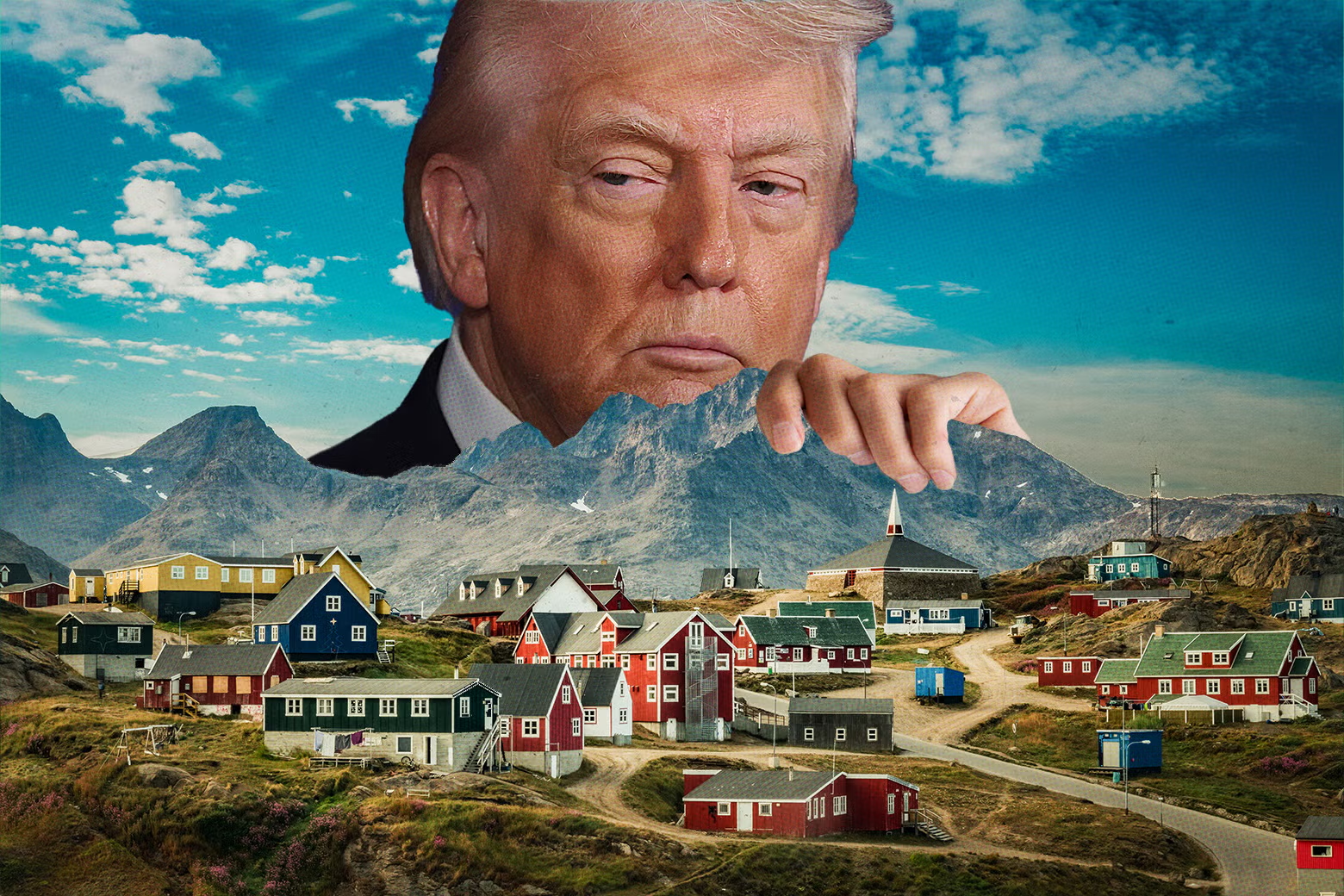
Donald Trump’s renewed talk of “buying” or even seizing Greenland has raised eyebrows across Europe. But viewed in light of his record, there is little reason for alarm. Again and again, Trump has relied on maximalist threats to grab attention, only to retreat once allies push back. Greenland fits that familiar pattern.
The episode is not new. In 2019, Trump floated the idea of purchasing Greenland, framing it loosely and insisting it was not a priority. When Denmark’s prime minister responded with understandable indignation that Greenland was “not for sale,” Trump immediately canceled a state visit and dropped the idea entirely. Everyone involved treated the pitch as mostly theatrical posturing. Every time Trump has threatened allies with sanctions or major disruption, he has softened his stance under pressure.
That same dynamic resurfaced this January. After vowing tariffs on Denmark, the United Kingdom and several NATO partners until Greenland was “completely and totally” sold to the U.S., Trump reversed course within days. Following a one-on-one meeting with NATO Secretary-General Mark Rutte at Davos, Trump announced he would not impose the planned tariffs and instead claimed to have negotiated a “framework of a future deal” over Greenland. The speed of this turnaround—from a “25% tariff starting June 1” to “no tariffs after all”—closely mirrors past behavior. In 2018 and 2019, he repeatedly threatened drastic tariffs on European cars and steel, only to suspend or reduce them after negotiations. He also declared in his first term that “NATO is obsolete” and proposed withdrawing U.S. troops from Germany but ultimately walked that back, leaving most forces in place. When Trump makes bold demands and European allies object, he typically backs down and settles for compromise. Even his aggressive Greenland rhetoric should be taken with a grain of salt.
Trump’s Greenland fixation is also largely a solo act, lacking real planning or bipartisan support. In December 2025, he appointed Louisiana Gov. Jeff Landry as a “special envoy” to Greenland to “lead the charge” on bringing it under U.S. control. Landry told reporters he didn’t expect military action, saying Trump favored offering “economic opportunities” and envisioned an independent Greenland closely tied to the U.S.
The Danish and Greenlandic governments have universally rejected any notion of a sale or takeover. Both prime ministers insisted Greenland “belongs to its people” and that any decision must involve Greenland, not the U.S. Europe has stood firm: On Jan. 6, 2026, seven EU leaders—from France, Britain, Germany, Italy, Poland, Spain and Denmark—issued a joint statement declaring that “Greenland belongs to its people … It is for Denmark and Greenland, and them only, to decide” its future. Even European far-right figures who once praised Trump have distanced themselves, deeming his threats unacceptable against a NATO ally. In practice, the entire Greenland affair has rallied European governments to reaffirm their sovereignty and collective defense.
From a security perspective, the U.S. already has significant rights in Greenland under long-standing treaties, limiting Trump’s actual leverage. A bipartisan 1951 defense pact gives the U.S. broad access to Greenlandic bases for missile warning and space surveillance. Danish Foreign Minister Lars Løkke Rasmussen noted that the U.S. already has wide military access to Greenland under this agreement. Denmark’s US Ambassador Jesper Møller Sørensen wrote that any further U.S. requests for an expanded presence “would be examined constructively and expeditiously.” In other words, the U.S. can already operate freely in Greenland through NATO channels – there’s no legal obstacle forcing Trump to “buy” the island to achieve his stated goals. Stine Bosse, a Danish MEP, added that under the 1951 treaty, the U.S. “can deploy all the military forces they want” in Greenland. In fact, the current U.S. commander of Pituffik Space Base (formerly Thule Air Base) emphasized that Greenland’s defense is in the hands of an alliance, not a weak Danish state, saying that his own own Arctic security forces see “no imminent threat from China or Russia today” and are already training to handle any future threats if needed. Thus, Denmark and NATO collectively form the line of defense, unaffected by Trump’s bluster.
Geopolitically, Trump’s Greenland gambit seems more like a personal quirk than a strategic move. While China and Russia both have Arctic ambitions—China has declared itself a “near-Arctic state,” and Russia is militarizing its northern coast—neither is attempting to seize Greenland. Greenland’s government has a clear Arctic strategy—“Nothing About Us Without Us”—focused on preventing militarization and maintaining peaceful relations. Its primary ties remain with Denmark and NATO, not China or Russia.
Chinese interest in Greenland’s mineral wealth has produced little real progress. Chinese bids to develop the Kvanefjeld rare-earth deposit were blocked over environmental concerns, and no Chinese-funded mine has started operating despite years of interest. Meanwhile, Russia’s Arctic strategy is centered on its own territory and the Northern Sea Route, not Greenland. Russian policy documents make no specific claims on Greenland. The real competition in the Arctic is already underway, with Russia rebuilding Siberian bases and China investing in icebreakers and Arctic infrastructure. Trump’s comments are not part of a coordinated alliance response but a solo act with little follow-through. Greenland’s neighbors—Canada and the Nordic countries—have clarified that Arctic security is a joint NATO effort and have already begun strengthening their defenses in response to broader competition between major powers. Denmark has clarified around 42 billion kroner to increase its Arctic military presence by 2025, showing that Europe is ready to do its part.
Trump’s tough talk has rarely translated into real policy. His NATO withdrawal threats never materialized, and troops remained in Europe. His boasts about tariffs often resulted in watered-down measures or delays. In his first term, he started a trade war with China and imposed steel tariffs on Europe but eventually reached a phase-one agreement with China and eased back on many of the threatened tariffs on allies. A Brookings analysis of Trump’s trade threats pointed out that early on, “many observers and foreign officials hoped that his promises were mere rhetoric,” which largely turned out to be the case for Europe. Similarly, his highly publicized border wall has been built in fits and starts, with large sections remaining incomplete. Each time, markets and allies have quickly adjusted once the initial shock subsided and the actual policies turned out to be less drastic.
Meanwhile, Denmark and its NATO allies remain firmly in control of Greenland’s future. The status quo will hold: NATO is responsible for Greenland’s defense, and Denmark retains sovereignty unless all parties agree to change that. In the context of Arctic geopolitics, Trump’s individual agenda is insignificant. European leaders are right to treat his comments as mostly talk. Greenland is “not on the market,” NATO’s role is unchanged, and the island’s future lies with its people and their government in Copenhagen—not with unilateral decisions from Washington. The Greenland talk is a rambling bluff that Trump will retreat from, and Europe’s alliances are sturdy enough to absorb it without real disruption.